C 언어를 이용하여 무작위로 영문으로 사람 이름을 만들어 보았다.
// C program to generate names and sort them
#include <stdio.h>
#include <stdlib.h> // for rand
#include <time.h> // for time
#include <string.h>
// Perform sort operation using bubble sort
void sort(char** names, int n) {
int i, j;
for (i = 0; i < n - 1; i++)
for (j = 0; j < n - i - 1; j++)
if (strcmp(names[j], names[j + 1]) > 0) {
char* temp;
temp = (char*)calloc(30, sizeof(char));
strcpy(temp, names[j]);
strcpy(names[j], names[j + 1]);
strcpy(names[j + 1], temp);
}
}
// Defining comparator function as per the requirement
static int myCompare(const void* a, const void* b)
{
// setting up rules for comparison
return strcmp(*(const char**)a, *(const char**)b);
}
int main() {
char** fullName;
char fullName2[40];
int n, i, j, cnt=0;
int duplicated = 0;
n = 50;
char *first[]={ "Alex", "Amy", "Andrew", "Andy", "Anthony",
"Ashley", "Bill", "Bob", "Connie", "Daniel",
"David", "Debra", "Diane", "Donna", "Emily",
"Emma", "Eric", "Frank", "Fred", "Gary", "Gill",
"Harry", "Jack", "Jake", "Jeffrey", "Joe",
"John", "Julie", "Kate", "Kevin", "Larry",
"Liz", "Marie", "Mary", "Michael", "Michelle",
"Monica", "Nancy", "Natalie", "Nicole", "Paul",
"Peter", "Rachel", "Ray", "Rick", "Richard", "Robert",
"Ryan", "Sam", "Scott", "Stephanie", "Steve",
"Susan", "Timothy", "Tom"
};
char *last[]={ "Abrahams", "Adams", "Anderson", "Ayers", "Blackwood",
"Brown", "Bryant", "Cooper", "Davis", "Ddavidson",
"Edgington", "Elmore", "Ferguson", "Fortini", "Gates",
"Gibson", "Gillmore", "Gray", "Hamington", "Harris",
"Henderson", "Hendrix", "Hudson", "Jackson",
"Johnston", "Jones", "Kuligowski", "Long", "Murray",
"Nance", "Netherly", "Petersen", "Putnam", "Robertson",
"Sampson", "Schmitz", "Smalley", "Smith", "Stanley", "Taylor",
"Washington", "Watson", "White", "Williams", "Wilson"
};
int size1 = sizeof(first)/sizeof(first[0]);
int size2 = sizeof(last)/sizeof(last[0]);
if( n > size1 * size2 ) n= size1 * size2;
fullName = (char**)calloc(n, sizeof(char*)); // allocating memory for 1st dimension
if(fullName==NULL) {
puts("Memory allocation error");
return 0;
}
for (i = 0; i < n; i++) {
// allocating memory for 2nd dimension
fullName[i] = (char*)calloc(30, sizeof(char));
if(fullName[i]==NULL) {
puts("Memory allocation error");
return 0;
}
strcpy(fullName[i], "NONE");
}
srand(time(0));
for (i = 0; cnt < n; i++) {
sprintf(fullName2, "%s %s", first[rand()%size1], last[rand()%size2]);
duplicated = 0;
for(j=0; j<n; j++) {
if(strcmp(fullName[j], fullName2)==NULL) { //duplicated
duplicated = 1;
break;
}
}
if( !duplicated && cnt < n) {
if( strcmp( fullName[cnt], "NONE" )==NULL )
strcpy( fullName[cnt++], fullName2);
}
if(i > 32767) break;
}
sort( fullName, n);
puts("\n***** Names ****\n");
for (i = 0; i < n; i++)
if( strcmp( fullName[i], "NONE" )!=NULL )
printf("%04d %s\n", i+1, fullName[i]);
for (i = 0; i < n; i++) {
free(fullName[i]);
}
free(fullName);
/*
qsort(first, size1, sizeof(const char*), myCompare);
for( i = 0; i < size1; i++ ) {
printf("\"%s\", ",first[i]);
if( i % 5 == 4) puts("");
}
puts("");
qsort(last, size2, sizeof(const char*), myCompare);
for( i = 0; i < size2; i++ ) {
printf("\"%s\", ",first[i]);
if( i % 5 == 4) puts("");
}
*/
return 0;
}
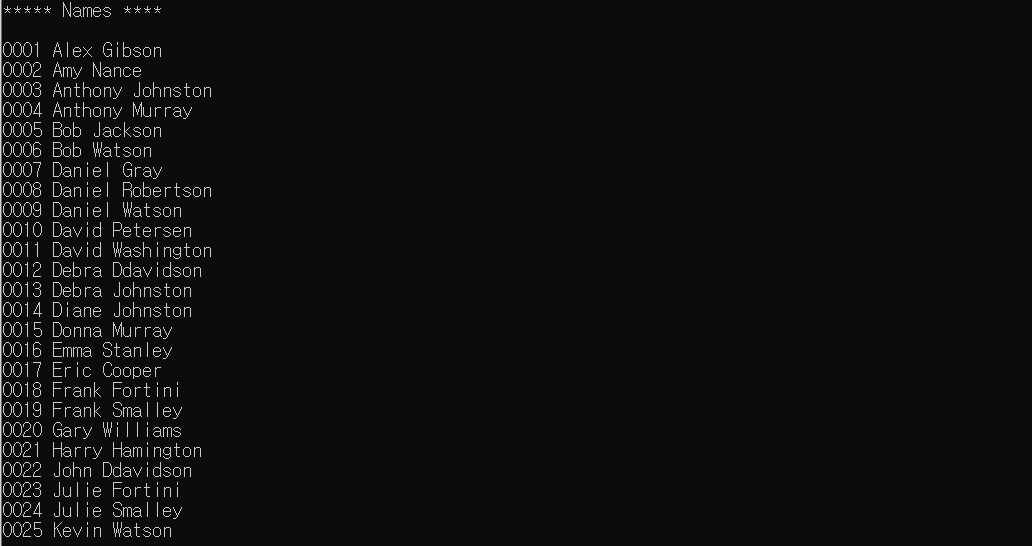
실행 결과는 아래의 그림과 같다.
'C 언어' 카테고리의 다른 글
| C 언어로 방정식의 해를 구하기 (Bisection method) (0) | 2020.12.31 |
|---|---|
| C언어로 현재 폴더의 모든 텍스파일 처리하기 (1) | 2020.12.31 |
| C 언어 Rand 함수를 이용해서 무작위 암호 만들기 (0) | 2020.12.16 |
| C 언어에서 한 줄 읽어 들이기 (0) | 2020.12.14 |
| C strtok 함수 (1) | 2020.11.19 |


댓글