자료구조에서 리스트는 매우 중요한 자리에 있는 것 같다.
Singly linked List를 응용하면, Doubly linked List나 tree 또는 graph 등을 구현할 때도 도움이 될 수 있기 때문이다.
아래는 Singly linked List의 예제이며, 아직 구현되지 않은 부분도 있다.
#include <stdio.h>
#include <stdlib.h>
#include <string.h>

// #define newFunc

typedef struct Node {
    char data[128];
    struct Node *next;
} Node;


Node* swap(Node* ptr1, Node* ptr2) {
    Node* tmp = ptr2->next;
    ptr2->next = ptr1;
    ptr1->next = tmp;
    return ptr2;
}

int bubbleSort(Node** head) {

    Node** h;
    int i, j, swapped;

    int cnt = 0;
    for(Node **p = head; *p; p = &(*p)->next) { //count number of nodes
        count++;
    }

    for (i = 0; i <= count; i++) {

        h = head;
        swapped = 0;

        for (j = 0; j < count - i - 1; j++) {

            Node* p1 = *h;
            Node* p2 = p1->next;

            if ( strcmp(p1->data, p2->data) > 0 ) {

                *h = swap(p1, p2);
                swapped = 1;
            }

            h = &(*h)->next;
        }

        if (swapped == 0)
            break;
    }
}

Node *selection_sort(Node* head) {

    Node* temp = head;
    Node* min;
    Node* p;

    char tmp_str[128];

    while( temp ) { /* Traverse the List */
        min = temp;
        p = temp->next;

        while( p ) { /* Traverse the unsorted sublist */
            if ( strcmp(min->data, p->data) > 0 )
                min = p;

            p = p->next;
        }

        strcpy(tmp_str, temp->data); /* Swap Data */
        strcpy(temp->data, min->data);
        strcpy(min->data, tmp_str);

        temp = temp->next;
    }

    return head;
}

Node *append(Node *head, char num[ ]) {    Node *p, *tmp;

    Node *n=(Node *)malloc(sizeof(Node));

    if( n == NULL) {
        printf("Error creating a new node.\n");
        exit(0);
    }

    strcpy(n->data, num);

    if(head==NULL) { n->next=head; head = n; return head;}

    for(p=head; p!=NULL; p=p->next)
        tmp=p;

    p=tmp;
    n->next=p->next;
    p->next=n;

    return head;
}

Node *push(Node *head, char *myword) {

Node *stone=(Node *) malloc(sizeof(Node));
strcpy(stone->data, myword);

stone->next=head;
head = stone;

return head;
}

#ifdef newFunc   // 아직 정리되지 못한 부분

Node *insertN(Node *head, int LOC, int num) {
   Node *p; int i; //Nodc *tmp;

   Node *n=(Node *)malloc(sizeof(Node));
   n->data=num;

   if(head==NULL || LOC==1) { n->next=head; head = n; return head; }

   for(p=head, i=1; p!=NULL && i<LOC-1; p=p->next, i++)
       ; //tmp=p;

   n->next=p->next;
   p->next=n;

   return head;
}

Node *deleteN(Node *head, int LOC) { int i;
   Node *p, *tmp;

   if(LOC==1) { tmp=head; head = head->next; free(tmp); return head; }

   for(p=head, i=1; p!=NULL && i < LOC; p=p->next, i++)
       tmp=p;

   tmp->next=p->next;
   free(p);

   return head;
}
#endif

Node *reverse(Node *head) { Node *p, *head2 = NULL;

   Node *tmp, *stone;

   for(p=head; p!=NULL; p=tmp) {
       tmp  =p->next;
       stone=p;

       stone->next=head2;
       head2=stone;
   }

   return head2;
}


Node *clear(Node *head) { Node *p, *tmp;

   for(p=head;p!=NULL;p=tmp) {
       tmp=p->next;
       free(p);
   }

   return (head = NULL);
}


Node *search(Node *head, char *find ) { Node *p; Node *sav;

   for( p = head ; p != NULL ; p = p->next) {
       if(strcmp(find, p->data) == 0 )  return p;
       sav = p;
   }

   return NULL;
}

int print(Node *head ) { Node *p;

   for( p = head ; p != NULL ; p = p->next) {
       puts(p->data);
   }

   return 0;
}

int main() {  Node *head = NULL;

    head = push(head, "cars");
    head = push(head, "trains");
    head = push(head, "airplanes");
    head = push(head, "ships");

    head = append(head, "hello");
    head = append(head, "tigers");
    head = append(head, "lions");
    head = append(head, "eagles");

    head = append(head, "flowers");
    head = append(head, "trees");
    print(head);

    //head = selection_sort(head);
    bubbleSort(&head);

    puts("\n***** after sort *****");
    print(head);

    head = reverse(head);
    puts("\n***** after reverse *****");
    print(head);

    head = clear(head);

    return 0;
}
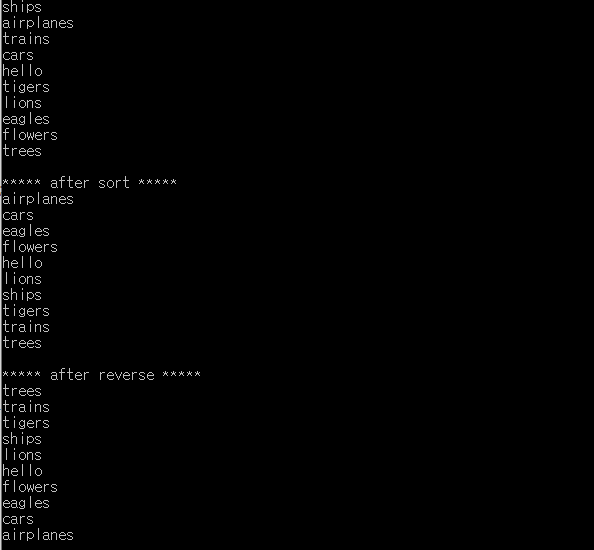
실행 결과는 아래의 그림과 같다.
'C 언어' 카테고리의 다른 글
| C언어를 이용해서 Log 함수 계산하기 (0) | 2021.01.01 |
|---|---|
| 매크로함수를 활용한 프로그램 (0) | 2020.12.31 |
| 텍스트 파일의 단어를 세는 프로그램 (C 언어 사용) (0) | 2020.12.31 |
| C 언어로 방정식의 해를 구하기 (Bisection method) (0) | 2020.12.31 |
| C언어로 현재 폴더의 모든 텍스파일 처리하기 (1) | 2020.12.31 |


댓글