C 언어에서 동적 배열을 사용하는 방법을 소개한다.
배열 크기를 2배로 증가하는 간단한 버젼은 맨 밑에 있으니 참고바란다. (에러체크는 생략되어서 간단하다.)
#include <stdio.h>
#include <stdlib.h>
#include <string.h>


void exit_if_null(void *ptr, char *msg) {
    if (!ptr) {
        printf("unexpected null pointer: %s\n", msg);
        exit(EXIT_FAILURE);
    }
}

int main() {

    char **arr = ( (void *) 0) ; // initialize to NULL

    int arrLen = 0;

    char input[40];

    for(int keepGoing = 1; keepGoing ; ) {

      puts("Enter fruit name (type \'end\' to finish.)"); scanf("%39[^\n]", input); while( getchar() != '\n' );

      if( input[0]=='e' && input[1]=='n' && input[2]=='d' && input[3]=='\0' ) {
          keepGoing = 0;
      } else {
           int found = 0;
           for (int j = 0; j < arrLen && !found; j++) {
               found = (strcmp( input, arr[j] ) == 0);
           }
           if(!found) {
              arr = realloc(arr, (arrLen + 1) * sizeof(*arr));
              arr[arrLen] = (char *) malloc(15);
              exit_if_null(arr[arrLen], "string malloc");

              strcpy( arr[arrLen], input );
              arrLen++;
           }
      }
    }

    puts("\n*** Your fruits list ***\n");
    for(int i=0; i < arrLen; i++ ) {
      puts(arr[i]);
    }

    for(int i=0; i < arrLen; i++ ) { // free each string
      free(arr[i]);
    }
    free(arr); // free the array

    return 0;
}
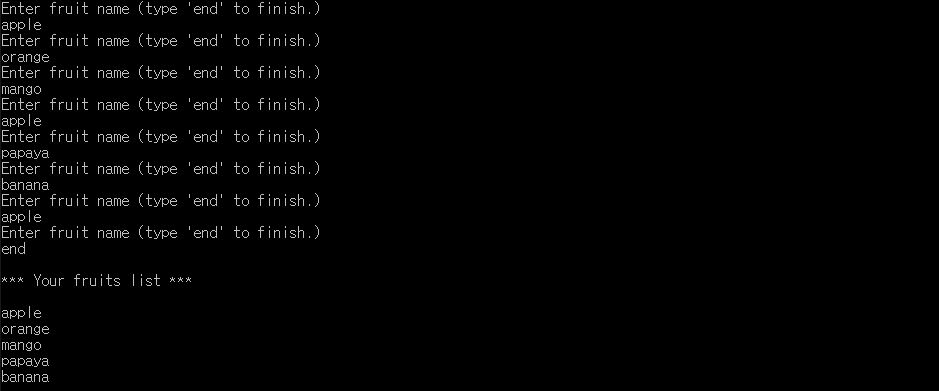
실행 결과는 아래의 그림과 같다.
------------------------
#include <stdio.h>
#include <stdlib.h>
#include <string.h>

int main() {

  char buf[128];

  char **aos = NULL;
  int maxlen = 0;
  int len = 0;

  while ( fgets(buf, sizeof(buf), stdin) ) {

      if (len == maxlen) {
            if (maxlen == 0) maxlen = 1;
            maxlen *= 2;
            aos = realloc(aos, maxlen * sizeof(*aos));
      }

      aos[ len ] = (char *) malloc( 100 );
      strcpy( aos[ len ], buf );
      len++;
      puts( buf );
  }

  return 0;
}
'C 언어' 카테고리의 다른 글
| C언어 구조체의 동적배열 사용하기 (2) (0) | 2021.02.16 |
|---|---|
| C언어 구조체의 동적배열 사용하기 (0) | 2021.02.08 |
| C언어 scanf 로 한 줄 읽어 들이기 (0) | 2021.02.06 |
| C언어 한글 정렬하기 (3) | 2021.01.28 |
| C 언어로 달력 만들기 (0) | 2021.01.24 |


댓글